
- Copoly Self-Adhesive Elastic Bandages for Sport
- Kinesiology Tapes
- Sports adhesive tapes – sports plaster and sports tape
-
Sports nutrition supplements
- Massage creams and oils
-
Sports Recovery
-
Equipment
- Medical bags and first aid kits
- Training Accessories
-
Fitness Equipment and Accessories
- Reaction and coordination training
- Coolers and insulated drink dispensers
- Aluminium transport boxes
- Goals, nets and accessories
- Home
- Manufacturers
- Contact



































Resistance, speed and agility training
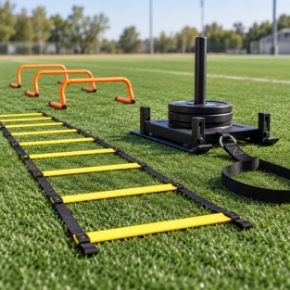
Plan acceleration and resisted-sprint drills around your training goal. This category includes sleds, parachutes, harnesses and belts for solo or partner work, depending on the model. Movement resistance is not measured identically across these accessories and does not replace specific change-of-direction drills.
How to choose
A sled uses its load and ground contact; a parachute creates air resistance during movement; a partner belt lets the partner control the pull. Choose by available space and training method, not just product size.
What to check before ordering
For sleds, check permitted surfaces, load limits and plate compatibility. Not every model is made for both pushing and pulling. For harnesses and belts, check fit, connectors, cord length and elasticity; a harness alone is not a complete system.
Use and precautions
Inspect attachments, seams, cords and structure before use. Keep the route clear and coordinate starts and stops with your partner, avoiding sudden jerks. Increase resistance progressively for controlled movement and respect both equipment and surface limits.
Frequently asked questions
Are weights included with a sled?
Only if stated in the product details. Check plates, belt, harness and cord separately in the package contents.
Does a parachute provide fixed resistance in kilograms?
Do not assume a fixed plate-weight equivalent; resistance depends on the model and movement conditions.
Do all sprint belts have elastic cords?
No. Non-elastic systems also exist; check the exact description and do not substitute unconfirmed cords or connectors.
Related categories

Training parachute 100cm - Sveltus


Training parachute - P2I


Training Sled - Barret

Training sled + ropes and harness